
Ever stood in front of three different bins, holding a piece of trash, and thought, “Where does this go?” 🤔 I did too, and that’s why I built a smart garbage separator that does the thinking for you!
In this post, we’ll build an AI-powered waste sorting system using ESP32, MicroPython, and Google’s Gemini API. It’s like having a recycling expert in your bin! 🗑️
⚡ Check out the project repository for the complete source code, detailed setup instructions, and to contribute to the project! Feel free to star the repo if you find it helpful. 🌟
Why Build a Smart Garbage Separator?
- Automated Sorting: No more guesswork about where trash belongs
- Better Recycling: Reduce contamination in recycling streams
- Educational: Learn about IoT, computer vision, and mechanical systems
- Fun Project: Combine hardware, software, and AI in one build
⚡ While commercial waste sorting systems cost thousands, we can build a working prototype for under $100!
What You’ll Need
Hardware Components 🛠️
- Seeed Studio XIAO ESP32S3 Sense (the brain with built-in camera)
- IR Sensor (the detector)
- 4 Servo Motors (the sorters)
- Stepper Motor (the conveyor)
- 16x NeoPixel LED Ring (to light up the waste for better camera visibility)
- 4x20 LCD Display (the informer)
Skills Required 🎯
- Basic Python programming
- Simple soldering
- Understanding of GPIO pins
- Experience with I2C and PWM protocols
The Build Process
Step 1: Hardware Setup
First, let’s connect everything according to this pinout:
# Key pin configurations
SERVO_PINS = {
    'front_1': 9,    # Front sorting mechanism
    'front_2': 8,    # Front sorting mechanism
    'drop_1': 7,     # Drop mechanism
    'drop_2': 44     # Drop mechanism
}

SENSOR_PINS = {
    'ir': 41,        # Object detection
    'neopixel': 1,   # Status indication
}

STEPPER_PINS = {
    'in1': 2,        # Stepper motor control
    'in2': 3,        # Stepper motor control
    'in3': 4,        # Stepper motor control
    'in4': 43        # Stepper motor control
}

I2C_PINS = {
    'sda': 5,        # LCD data line
    'scl': 6         # LCD clock line
}
Think of this pinout as a recipe for connecting all our components. Each pin has a specific job, just like ingredients in a recipe! 🧩
Step 2: The Magic Code
Here’s the main control loop that makes everything work:
async def main_loop():
    while True:
        if ir_sensor.detect_object():
            # Capture image
            image = camera.capture()

            # Classify waste
            category = await classify_waste(image)

            # Sort waste
            await sort_waste(category)

            # Update display
            lcd.show_status(category)

            # Indicate success
            neopixel.show_success()
This code is like a well-choreographed dance! 🕺 Each component plays its part:
- The IR sensor spots the waste (like a bouncer at a club)
- The camera takes a photo (our AI’s eyes)
- Gemini API identifies the waste (the brain)
- Stepper motor moves it along (the conveyor)
- Servos drop it in the right bin (the hands)
- LCD and NeoPixels give feedback (the voice)
How It Works
- Detection: IR sensor spots incoming waste
- Imaging: Camera captures the item
- Classification: Gemini API identifies the waste type
- Sorting: Servos direct the item to the right bin
It’s like having a tiny recycling expert inside your bin! 🧠
Project Structure
Garbage-IoT/
├── Garbage-Separator.py    # Main application code
├── neopixel_driver.py      # NeoPixel LED control
├── motor.py                # Stepper motor control
└── machine_i2c_lcd.py      # LCD display control
Each file has its own superpower! 🦸♂️
Challenges and Solutions
🎯 Challenge 1: Real-time Processing
The ESP32’s limited processing power made real-time image analysis challenging.
Solution: Optimized image capture and processing routines.
🎯 Challenge 2: Mechanical Reliability
Servo motors needed precise timing.
Solution: Implemented a state machine for reliable motor control.
🎯 Challenge 3: Power Management
Multiple motors and sensors required careful power management.
Solution: Added power monitoring and sleep modes.
Every challenge is just a puzzle waiting to be solved! 🧩
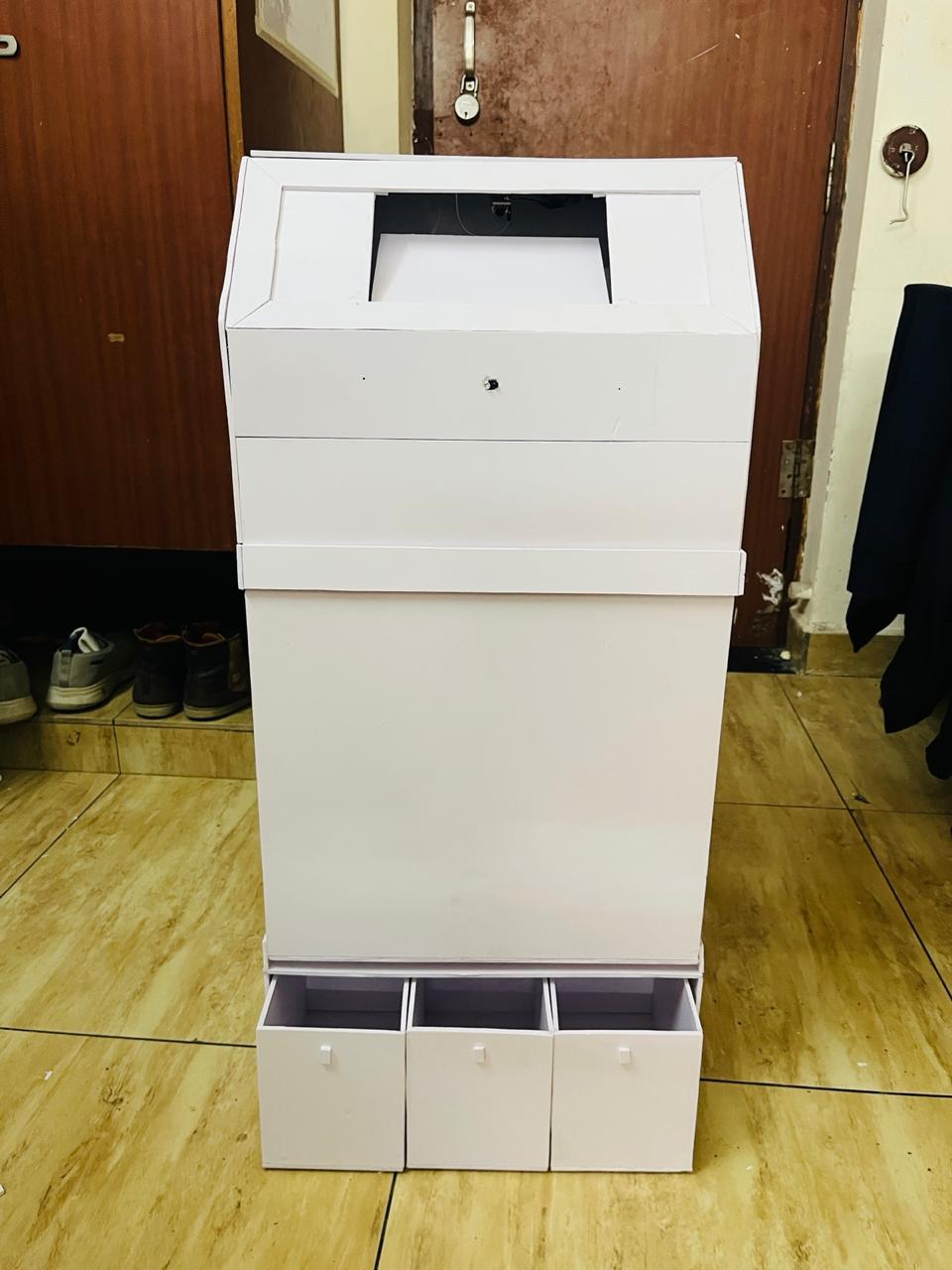
Project Final Photo
📸 The completed smart garbage separator in action
Troubleshooting Tips
Camera not working?
→ Check power supply and I2C connectionsServos acting weird?
→ Verify PWM frequency and duty cycleWiFi issues?
→ Double-check credentials and signal strength
Remember: Every bug is just a feature in disguise! 🐛
Useful Links
Project Evolution and Next Steps
While this project has reached a stable state, here are some potential areas for future development:
- Weight Sensors: Adding weight sensors could improve categorization accuracy
- Mobile App: A companion app for monitoring and control
- On-device ML: Implementing machine learning directly on the ESP32S3
- Analytics: Adding waste composition tracking and reporting
The future is full of possibilities! 🚀
Built with ❤️ and a lot of coffee ☕